
Spot plains spotted skunks
The Nebraska Game and Parks Commission is looking for sightings of the plains spotted skunk within the state. We are asking you to report any potential sighting, past or present, to our agency.
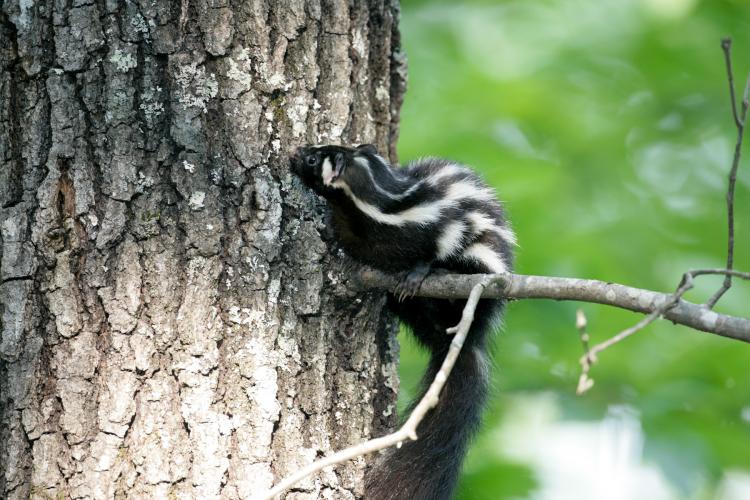
Populations of plains spotted skunks, also known as a polecat or civet cat, have decreased throughout much of their range. This is especially true in Nebraska. Once a common sight around Nebraska farms, this small skunk has only been recorded three times since 2017. The most recent confirmed sightings occurred in 2025 in Keya Paha County about 6 miles apart from each other.
Because this is an elusive and nocturnal species, you may see spotted skunks on trail cameras or as roadkill. Sites near old farm structures, fence rows, hay bales, rock piles, or abandoned equipment and junk yards may be used by this skunk. They are also well adapted to climb trees.
Report a sighting
Any and all sightings of this nocturnal species should be emailed to [email protected]. Reports should include pictures, sighting date, and the location of sighting; please provide GPS coordinates if possible.
You also can report a sighting by calling 402-471-5708. Private location information will not be shared publicly.
How to ID Spotted Skunks
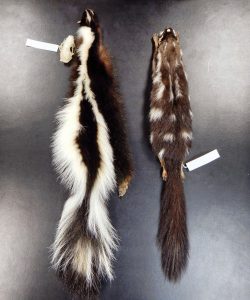
In the photo above, a striped skunk (Mephitis mephitis) is on left and a spotted skunk (Spilogale interrupta) is on right. Notice that spotted skunks are smaller, about the size of a large fox squirrel (0.5 to 4 pounds), while striped skunks are about the size of a house cat (5 to 10 pounds). Spotted skunks have broken stripes which appear as spots, while striped skunks have two bold stripes. Spotted skunks also have a small triangle marking on their forehead as opposed to a line down their forehead.
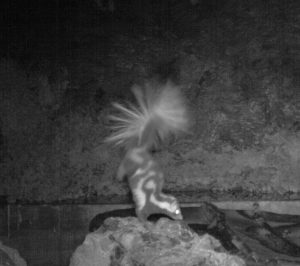
Spotted skunks also lift their back legs into a headstand when threatened, as shown in the photo above.
Help in the search for plains spotted skunks
Review camera trap images
University of Nebraska Omaha and Nebraska Game and Parks Commission are conducting a camera trap survey project across Nebraska. The goal of this project is to find observations of the rare plains spotted skunk in the state. We are asking for help to review and tag the images collected. Please visit Nebraska Wildlife Watch on Zooniverse to learn more!
Set up camera traps
We are recruiting interested landowners, conservation organizations and others who can independently set up and monitor game cameras to help us successfully capture images of spotted skunks in the Nebraska. Those interested should:
- Review the Participation Guidelines to determine if this project is a good fit for you.
- Register to be a Nebraska Spotted Skunk participant.
- Follow the Participant Guidelines to set up your camera’s traps.
- Send images collected to project coordinators (information on how to do this will be provided after registration).
For questions or more information, email [email protected].
Have you seen me?
Download — and share — our HAVE YOU SEEN ME? poster and inspire others to get involved, too.

More information on spotted skunks
The smallest of all North American skunks, the plains spotted skunk (Spilogale interrupta) has a deep black colored body and bushy tail with white- to yellowish-white broken stripes that resemble spots. The plains spotted skunk is usually found in open woodland edge, grasslands with woody shrubs, fence rows, and riparian areas. They use abandoned farm buildings, tree roots, and other animal burrows as dens. Spotted skunks are excellent climbers and are faster and more agile than their cousins, the striped skunk.
These nocturnal creatures are seldom seen during daylight. They are considered mainly omnivores, as skunks will eat insects, small mammals, and carrion, as well as wild fruits and vegetable matter.
It is theorized that small farms in the early 20th century provided shelter for the spotted skunk. The food supply of skunks may have increased as mice and rats were attracted to crops that were grown and stored on farms. Humans may also have enhanced populations of plains spotted skunks by decreasing populations of competing and predatory animals. There is continuing speculation as to the cause of the decline in spotted skunk populations and abundance, but it is theorized that the decline in spotted skunks may be associated with the decline of small farmsteads and the expansion of larger scale farms.
Since the 1940s the populations of the plains spotted skunk in Nebraska has decreased significantly and has yet to rebound. Changes in agricultural practices in the late 1940s have reduced habitat, and pesticides may have reduced an important food source. Few records of this once common species have been documented over the last few decades.
Today, the decline of the plains spotted skunk is still a mystery and the Commission is working to learn more about where they persist and we are asking for the public’s help.
In Nebraska, the plains spotted skunk is ranked as a Tier 1 species in the Nebraska Natural Legacy Project, considered to be critically imperiled within the state with the two most recent sightings occurring in Keya Paha county in 2025, and before that only one in 2017.
The USFWS has the plains spotted skunk under review for possible listing on the threatened/endangered species list. As a native species to the state, and an important element of the state’s natural heritage, it is imperative to have an accurate accounting of the spotted skunk’s abundance and distribution in Nebraska.
As a species of great concern, the Commission needs your help to obtain accurate accounts of their location, activities, and numbers.